
Casino Promotions Explained: Free Spins, Cashback, and More

Quick Say-So
- Fine print
- “Casino promotions only pay out what their wagering terms allow. The type of promotion determines whether you get most of…”
- Okey Dokey says
- Casino Promotions Explained: Free Spins, Cashback, and More
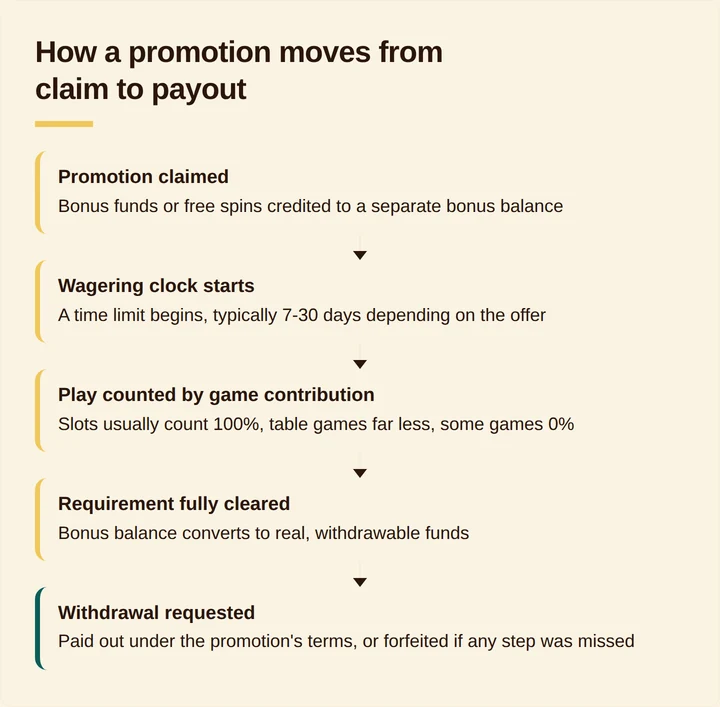
Casino promotions only pay out what their wagering terms allow. The type of promotion determines whether you get most of the advertised value or almost none of it. A wager-free cashback credit and a fifty-times-wagering free-spin package both get called “bonuses.” The two have vastly different actual values.
Free Spins: The Most Common Promotion
Free spins give you a set number of spins on specific slot games without using your own money. A typical offer ranges from 10 to 200 spins. The number is inversely related to per-spin value. More spins usually means lower value per spin.
Free spins come in three formats, and the format changes everything:
| Format | Outcome |
| Wager-free spins | Winnings go straight to your withdrawable balance |
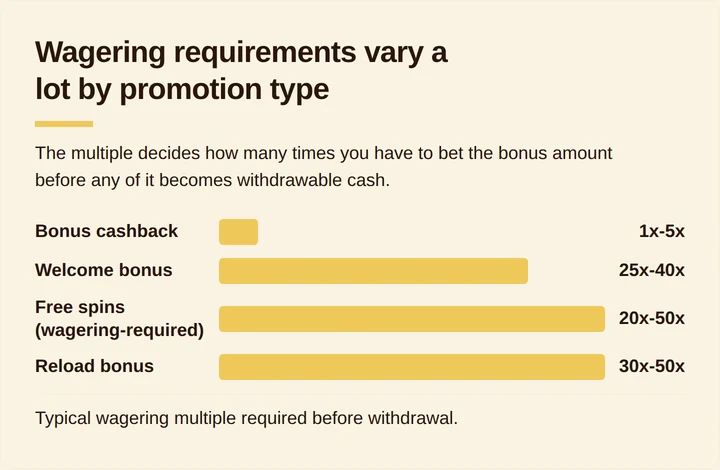
| Wagering-required spins | Winnings convert to bonus funds requiring 20-50x wagering before withdrawal |
| No-deposit free spins | No deposit required, but winnings typically cap at $50–$100 regardless of what you actually win |
The gap between these formats is enormous. Wager-free spins have real value because you keep everything you win. Wagering-required spins mean that a twenty-dollar win needs twenty to fifty times that amount in additional bets before it becomes cash. No-deposit spins appear generous until you hit the cap, which cuts off most winnings. Win three hundred and you still only withdraw fifty.
Most free spins lock you to specific slots chosen by the casino, usually newer releases or games with lower RTP that favor the house more heavily. You can’t apply them to your preferred high-RTP titles. I’ve claimed free spins on slots I’d never normally play. The casino controls which games are available for your spins.
Cashback Offers: Recovering Losses
Cashback promotions return a percentage of your losses over a set period, typically between five and twenty-five percent. Lose one hundred dollars with ten percent cashback and you get ten back. That arithmetic is simple. The calculation method matters as much as the percentage itself.
Some casinos calculate cashback on net losses, meaning wins subtracted from deposits. Others calculate on total amount wagered regardless of wins. The method dramatically changes the payout. Deposit one hundred dollars, win eighty of it back during play, and stop. Net-loss cashback pays out on the twenty-dollar gap between deposit and what’s left, while total-wagered cashback can pay out on the full amount put into play regardless of that gap.
Cashback comes in two main forms:
| Type | Details |
| Wager-free cashback | Deposits directly as withdrawable cash |
| Bonus cashback | Requires 1x–5x wagering before withdrawal |
Wager-free cashback offers actual money back with no strings attached.
Bonus cashback adds requirements that reduce its real value. A five-times wagering requirement on a ten-dollar credit means fifty dollars in bets before you see a cent. Operators do personalize cashback offers using player data, targeting different percentages to different segments based on activity. Always check what rate you’re actually being offered. Your eligibility and the specific percentage you qualify for both depend on your player history, deposit patterns, and account status.
Reload Bonuses: Ongoing Deposit Matches
Reload bonuses work like welcome bonuses but target existing players making additional deposits. A typical reload offers a match capped at several hundred dollars, whereas welcome bonuses reach higher limits for new customers.
Reload bonuses compared to welcome offers:
| Characteristic | Reload Bonus | Welcome Bonus |
| Match percentage | 25–50% | 100%+ |
| Maximum amount | $200–$500 | $1,000+ |
| Wagering requirement | 30x–50x | 25x–40x |
| Time limit | 7–14 days | 30 days |
| Game restrictions | More restrictive | Fewer restrictions |
The goal is reactivating dormant accounts and encouraging additional deposits from existing customers.
Casinos send reload offers through email, SMS, or account notifications, usually targeting players who haven’t deposited recently. I’ve let a reload bonus sit unused because the wagering requirement on a fifty percent match simply wasn’t worth the deposit. The math rarely works in your favor on these offers. For most players, the combination of lower match percentages and higher wagering thresholds compared to welcome bonuses makes the actual value questionable. Your expected loss on the wagering requirement often exceeds the bonus credit itself.
Loyalty Programs and VIP Tiers
Loyalty programs reward regular play by accumulating points that convert to bonus funds, free spins, or other perks. You earn points based on wagering volume, with different games contributing different amounts toward point accumulation.
Most programs use a tiered structure with escalating benefits:
| Tier | Benefits |
| Bronze/Silver | Entry tiers with basic point earning and minimal perks |
| Gold/Platinum | Mid-level tiers with improved exchange rates and monthly bonuses |
| Diamond/VIP | Top tiers with personal account managers and exclusive promotions |
| Invitation-only | Elite tiers for high rollers with customized benefits |
Loyalty tiers commonly use data-driven segmentation to customize rewards. That’s standard industry practice.
What the points are worth matters more.
The point-to-cash exchange rate determines actual program value. A rate requiring many points to convert to a single dollar, with minimal points earned per dollar wagered, means you need massive bets to generate meaningful rewards. That’s a tiny return, far below most games’ expected loss rate. You’re paying for those loyalty perks through your play, and for most players the math doesn’t close. The worked example below illustrates this gap. If you need one thousand points to earn a single dollar, and you earn one point per ten dollars wagered, you must wager ten thousand dollars to earn a one-dollar reward. That 0.01% return barely compensates for the house edge you’ve already paid.
| Metric | Value |
| Points needed for $1 reward | 1,000 |
| Wagered per point earned | $10 |
| Total wagered for a $1 reward | $10,000 |
| Effective return | 0.01% |
Tournament and Leaderboard Promotions
Tournaments create competitions where players compete for prize pools by accumulating points through qualifying play. Leaderboards track performance and award prizes to top finishers, typically paying out many positions depending on tournament size.
Common tournament structures include:
| Type | Description |
| Buy-in tournaments | Entry fees fund the prize pool |
| Freeroll tournaments | Free entry, prizes funded by the casino |
| Scheduled tournaments | Specific times with set durations |
| Ongoing leaderboards | Tracking performance over weeks or months |
Most tournaments concentrate the majority of prizes at the top positions.
Tournament value depends heavily on the prize structure and competition level. A large prize pool sounds impressive until you see it split among many winners. First place might get a substantial amount while lower positions get minimal payouts. The payout curve is steep, and unless you’re genuinely competitive at the top, your expected return is minimal. Consider that in a ten-thousand-dollar pool split among one hundred winners, first place takes two thousand while positions fifty through one hundred each receive only twenty dollars. For most participants, the time investment in qualifying for a tournament rarely justifies the low-payout positions you’re likely to reach.
| Position | Payout (example: $10,000 pool, 100 winners) |
| 1st place | $2,000 |
| Positions 50–100 | $20 each |
Time-Limited and Flash Promotions
Flash promotions appear for short periods, typically twenty-four to forty-eight hours, creating urgency through limited availability. These include happy-hour deposit bonuses, weekend cashback specials, and holiday-themed offers around major events.
The short timeframes serve two purposes. They create urgency that drives deposits and play during specific windows. They also let casinos run aggressive terms at high cost without sustaining those costs long-term.
Flash promotions thrive on creating time pressure.
Flash promotions often offer better terms than standard ongoing ones. A reload bonus that normally maxes out might jump to higher amounts during a weekend special. Cashback might increase for a single day. The terms themselves are usually the same structure with same wagering and same game restrictions, just with a higher headline number for a limited window. The increased headline numbers, whether a reload cap jumping from two hundred to five hundred dollars or cashback rising from ten to twenty percent, are the only real difference. These changes last only as long as the promotion window. Outside that window, you’re back to standard rates.
| Promotion | Standard terms | Flash-promo terms |
| Reload bonus cap | $200 | $500 |
| Cashback rate | 10% | 20% |
Game-Specific Promotions
Many promotions target specific games or game providers, often tied to new releases. A casino might offer free spins on a newly launched slot, enhanced RTP on specific tables for a weekend, or leaderboards tied to one provider’s titles.
These serve marketing purposes for both sides.
The casino gets content to promote and traffic directed to new releases. The game provider gets exposure for their latest titles. You get promotional value within narrow constraints limiting which games you can play.
Conclusion
Casino promotions range from genuinely valuable wager-free offers to restrictive promotions designed primarily as marketing tools. Free spins value depends entirely on wagering requirements and game restrictions. Cashback is only valuable when it’s wager-free. Reload bonuses typically offer worse terms than welcome bonuses. Loyalty programs require massive wagering to generate meaningful returns. Tournaments concentrate value at the top.
Read complete terms before claiming anything. Calculate the actual wagering required for your preferred games, and compare the time investment to potential payout. The best promotions match your natural playing style without forcing behavior changes or requiring unrealistic wagering volumes.
FAQ
How can I tell if a promotion is wager-free before claiming it? Look for the wagering requirement in the terms. If it says “no wagering” or “wager-free,” winnings go straight to your withdrawable balance. If the terms mention a multiplier such as twenty-times or higher, that applies to your winnings before withdrawal.
Why do reload bonuses have worse terms than welcome bonuses? Welcome bonuses compete for new customers, so casinos offer aggressive matches. Reload bonuses target existing players who’ve already shown they’ll deposit. Casinos don’t need to be as generous, so match percentages drop significantly and wagering requirements rise.
Are loyalty points worth chasing for an average player? Usually not. Most programs require massive betting to generate even minimal rewards. The return rate doesn’t offset the house edge you’re paying along the way.
How do tournament leaderboards actually pay out? Prizes go to top finishers, typically many positions depending on size. The payout curve is steep. First place gets a substantial amount while lower positions get minimal payouts. Check the full prize structure before committing time.
Are flash-promotion terms the same as standard ones? The structure is usually identical with same wagering requirements and same game restrictions. But the headline numbers get bigger for the limited window. A reload with one cap might rise to a higher cap, or cashback percentages might increase, for a short time.