
Casino Geolocation Restrictions and Why Your Access Changes by Region
Quick Say-So
- Fine print
- “Your casino access changes by region because location is re-verified continuously throughout a session, well past the one-time check most…”
- Okey Dokey says
- Casino Geolocation Restrictions and Why Your Access Changes by Region
Your casino access changes by region because location is re-verified continuously throughout a session, well past the one-time check most players expect at sign-up. Regulated platforms check a stack of signals, IP address against VPN/proxy/datacenter databases, GPS on mobile, Wi-Fi triangulation, and each regulator only recognises its own licence. Cross a border, and both the technical check and the legal permission fail at the same time.
That is the whole mechanism in two sentences. The rest of this article is the detail. It covers what the check actually inspects, why a licence in one country buys nothing in another, what happens when you cross a state line mid-session, why reaching for a VPN makes the problem bigger, and the quieter check most players never see coming, the one run against your payment card.
How a casino actually checks where you are
The popular mental model is a single lookup. The site takes your IP, compares it to a country list, and either lets you in or doesn’t. That model is out of date, and it was never accurate for mobile.
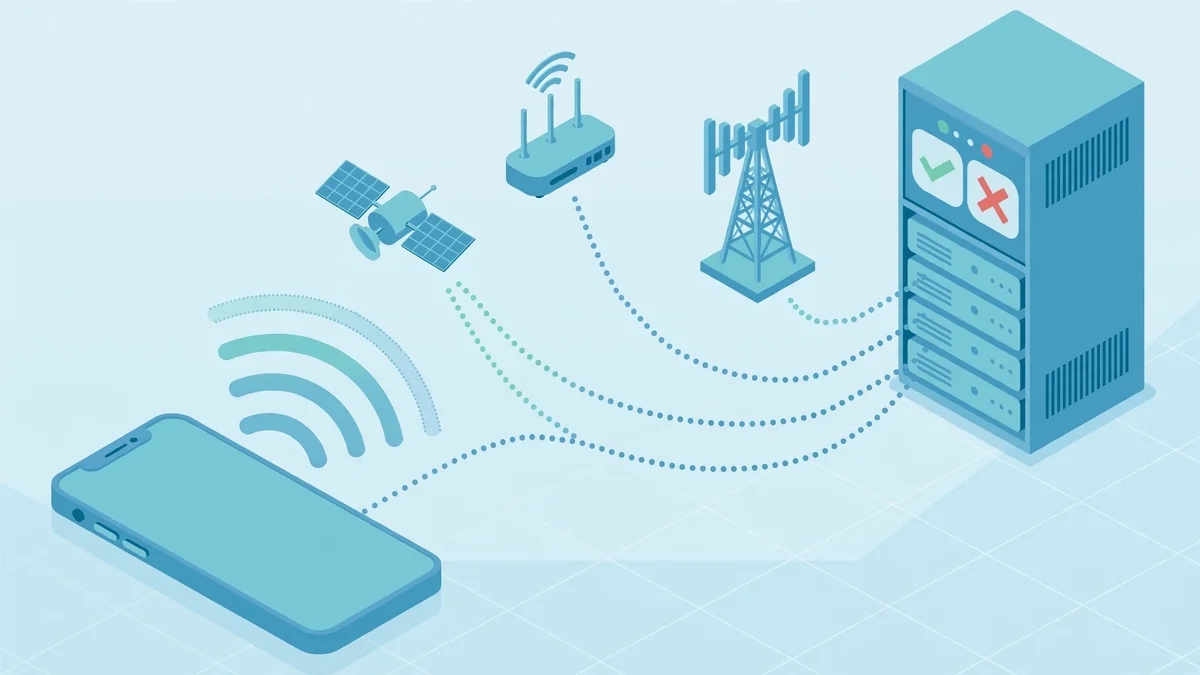
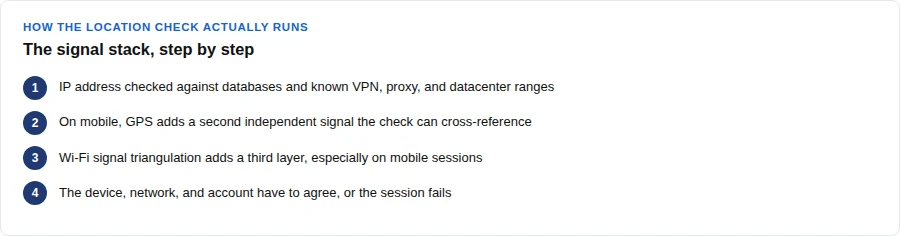
A regulated platform verifies location using a stack of signals. The IP address is checked against databases and against known VPN, proxy, and datacenter ranges. On mobile devices, GPS is used. Wi-Fi signal triangulation adds a third layer. Desktop IP-only checks are materially weaker than mobile GPS-plus-Wi-Fi checks. A desktop browser has fewer independent signals to cross-reference, which is why the same account can pass on a phone and fail on a laptop in the same room.
The depth is the part that surprises people. Geolocation verification software used by regulated operators runs a long stack of individual checks beyond a simple IP lookup, covering device integrity, user integrity, and anonymizer detection. A single IP lookup is one check among that whole stack. The rest exist because a determined user with a proxy can defeat any single check, and the regulator knows it.
The practical consequence. You are being scored on whether the device, the network, and the account agree with each other. When they disagree, the system doesn’t ask which one is right. It fails the session.
Why a licence in one country doesn’t travel to another
Here is the rule that makes the technical check make sense: licensing is jurisdiction-exclusive.
A UK Gambling Commission licence is only recognised inside the UK. An MGA (Malta) licence authorises an operator under Malta’s framework, which doesn’t automatically carry legal weight in a market with its own separate licensing regime. Neither one is a passport. The regulator that issued the licence has authority over a defined territory, and it has no authority, and no interest, in whether you can play from somewhere else.
The Curaçao case is the one most players get wrong. A Curaçao licence authorises an operator to run a casino. It says nothing about which markets that casino may legally reach, and it does not entitle an operator to accept players from markets that run their own national licensing regimes. Curaçao-licensed operators are expected to geoblock every nationally regulated market, because it’s that market’s own law doing the requiring. This includes the US, the UK, France, the Netherlands, Australia, and EU countries with their own national licence regimes. The UK enforces that same exclusivity from the other direction too. Many operators without a UKGC licence geo-block UK traffic by default to avoid the risk entirely.
So when a Curaçao-licensed site blocks you, it is protecting the licence that lets it operate at all. Accepting a UK player without a UKGC licence is the kind of thing that gets a licence reviewed.
There is a reason the blocking is so aggressive. Curaçao’s gaming regulator audits licensed operators for compliance, and the licence itself is what’s on the line if that audit goes badly. From the operator’s seat, one player from a blocked territory is a compliance event. A pattern of them is an existential one. The geoblock is self-preservation.
Crossing a line mid-session
The US is the cleanest illustration because the lines are state lines, and the legal map is genuinely fragmented.
As of late 2026, a small number of states have legalised and launched real-money regulated online casinos, among them New Jersey, Pennsylvania, Michigan, West Virginia, Delaware, Connecticut, and Rhode Island. That list shifts as legislation moves, so treat it as a snapshot that will age.
A small handful of states out of fifty. That means a player in a legal state can be a short drive from a state where the same account cannot legally accept a wager. And every regulated US online casino must prove to its state regulator that no wager is accepted from outside the licensed state boundary, using specialist geolocation vendors built for exactly this job.
The boundaries themselves are not simple straight lines, each state draws its own regulator-approved zone, with carve-outs specific to that state’s geography and gaming compacts. These shapes are the ones the regulator actually approved, and the vendor enforces them.
Now for the failure modes, which are more mundane than most players expect.
You move states mid-session. The next location check fails. The session locks. You may be told to contact your ISP to resolve the mismatch. This is unhelpful advice if the mismatch is that you are physically in the wrong state.
Your ISP assigns an out-of-jurisdiction IP. This is the one that catches people who never moved at all. An IP registered to a different jurisdiction fails the check even though your physical location is fine. The usual remedy is to contact your ISP, because the geolocation database’s record of that IP range can lag behind reality. A fresh router assignment can sit tagged to the wrong jurisdiction for a stretch, which means a hardware swap alone can trigger a short lockout with no change in where you actually sit.
Here is the consequence in access terms. A lockout feels identical to a ban while it lasts, even though the account itself was never closed. The session simply cannot proceed, and the clock runs on whatever bonus wagering you had in progress.
Why a VPN backfires
The intuitive fix for a regional block is a VPN. In practice, a VPN converts a temporary access problem into a permanent account problem.
Most online casino terms of service explicitly prohibit VPN or proxy use to mask location. Detection can lead to immediate account closure and forfeiture of winnings and bonus funds, and in some cases the deposited balance too, with little to no avenue for appeal, because the player breached the contract by circumventing geolocation. Exact terms vary by operator and jurisdiction, but the direction is consistent.
Note what is being forfeited. What typically goes first is the winnings and the bonus funds, and the deposit can go with them, because the breach taints the entire account relationship, extending well beyond the promotional funds. If you were mid-wagering on a bonus when the VPN was detected, the forfeiture lands on top of an already-unfinished requirement. This failure mode is covered in the common mistakes players make when claiming casino bonuses, where a terms breach and an unmet wagering requirement both land on the same account at once.
On the detection side, the site doesn’t block your country. It blocks your IP range, cross-checked against the licence that governs it. A VPN is supposed to hide your real location, but a WebRTC leak can expose the underlying address even while the tunnel is up, and the casino’s anonymizer-detection check catches that leaked location anyway. That check stack includes anonymizer detection precisely because VPN use is the first thing a location-restricted player tries.
The terms read similarly across much of the industry, and the outcome tends to match. A blocked account, a forfeited balance, no real path back.
The operator-side mirror from the previous section applies here too. A player arriving through a VPN looks, from the compliance dashboard, like traffic from a restricted territory, the exact pattern that draws regulatory scrutiny. The operator has every incentive to close the account quickly and document it, because the alternative is explaining to a regulator why the traffic kept arriving.
The payment layer runs its own check
Everything above concerns where the session originates. There is a second geolocation layer that runs at the payment step, and it doesn’t care what your IP says.
A card’s BIN, the first 6-8 digits, identifies the issuing bank and the issuing country. Payment processors compare the card’s issuing country against the player’s detected billing and location country. A mismatch doesn’t prove fraud; travellers are legitimate, and processors know it. But a mismatch commonly triggers step-up verification (3D Secure, address check) or an outright decline.
Then there is the merchant category code. Online casino and betting transactions are commonly designated MCC 7995 (“betting and casino gambling”), and some card issuers decline that code by default regardless of location. The decline is driven by the purchase category itself, independent of where the player happens to be.
Put the two together and you get the failure that confuses people most. The location check passes, the account is in good standing, and the deposit still declines. The IP said yes. The card said no. From the player’s side both look like “the casino blocked me,” but they are different systems with different remedies. One is resolved by fixing your network, the other by using a payment method your issuer will actually authorise for that merchant category code.
The payment layer also explains why a VPN “fix” can cascade. Mask your location, and the BIN-versus-location comparison now has a reason to mismatch that it didn’t have before. You’ve added a second check that fails independently of the first.
What this means in practice
Three layers decide whether you can play, and they fail independently. The licence determines whether the operator is permitted to accept you at all, and it is territory-bound by design. A UKGC licence stops at the UK border, an MGA licence stops where Malta’s framework stops, and a Curaçao licence authorises the operation itself without authorising access to any specific market. The signal stack determines whether the platform believes you are where you say you are, cross-referencing IP, GPS, Wi-Fi, device integrity, and anonymizer detection against each other. The payment layer determines whether your money can move, using the card’s issuing country and the merchant category code.
A VPN interferes with the second layer and can trip the third. It never touches the first. That is why it converts a regional block into a forfeiture. The licence restriction was never the thing the VPN could solve, and the attempt to route around it is itself a breach.
Access changes by region because two separate systems, one legal and one technical, are both doing their jobs, and neither one is negotiable at the player level. If your access changes, the useful question to ask is “which of the three layers failed,” because the answer determines whether the fix is a network setting, a different payment method, or simply the recognition that this particular market isn’t open to you.
FAQ
Can I use a VPN to access a casino blocked in my country?
You can, technically, and most terms of service prohibit it. Detection can mean account closure and forfeiture of winnings and bonus funds, sometimes the deposited balance too, with little appeal route, because circumventing geolocation breaks the contract outright. The check stack includes anonymizer detection, and WebRTC leaks can expose your real location even through a working tunnel.
What happens if I travel to a different state or country mid-session?
The next location check fails and the session locks. In the US, every regulated operator must prove to its state regulator that no wager is accepted from outside the licensed state boundary, so a move from a legal state into a non-legal or differently licensed one produces a lockout. You may be advised to contact your ISP, which doesn’t help if the issue is that you physically moved.
Why did my deposit get declined when my location check passed?
Because the payment layer runs its own check. Your card’s BIN identifies the issuing bank and issuing country, and processors compare that against your detected billing and location country. A mismatch can trigger step-up verification or a decline. Separately, the same merchant category code is declined by many issuers by default, regardless of where you are.
Does closing the VPN fix a blocked account?
Not usually. The block is typically applied after detection, and detection means the terms were already breached. Turning the VPN off restores an accurate location signal but doesn’t reverse a closure decision or restore a forfeited balance. The appeal route is thin by design. Operators generally treat this as a broken contract, and flipping a setting back doesn’t repair a broken contract.
Why does the same account work on my phone but not my laptop?
Mobile devices supply GPS and Wi-Fi triangulation on top of the IP check; desktop IP-only checks are weaker and have fewer independent signals to cross-reference. A desktop session can fail a check a phone would pass, simply because the phone has more signals available to confirm where it actually is.